
Among the search queries that led people to our blog was one typed almost exactly as it must have appeared in a questionnaire (translated from Russian): "tell us everything you consider important about yourself as part of the 360 review, example of a comment about yourself". Behind queries like this sits a familiar moment, when someone has already given their colleagues and themselves scores from 1 to 5, reached the open questions and has no idea what to put in the empty box so that it reads neither as a brush-off nor as a complaint.
The hesitation is reasonable, because people read the comments in a 360 report more closely than any number, and it's the comments that most often explain why someone got the score they did. The empty box causes the most trouble in three cases, a comment for a peer, a comment for a manager and a comment about yourself, and each of them needs its own phrasing. All the examples in this article are hypothetical, and the people and situations in them were invented for illustration.
Why a few precise comments help more than a long list of complaints
James Smither and Alan Walker looked at how comments in upward feedback related to changes in managers' ratings a year later. The study covered 176 managers, and the authors coded the number of comments, their tone and whether each comment addressed behaviour and tasks or personal traits. Managers who received a small number of critical comments about specific behaviour improved their ratings more than others a year later, while managers who received a large number of such comments declined more than others.[1]
The practical conclusion for anyone writing a comment is that one or two precise remarks about behaviour give the person something to work with, whereas a long list of grievances is more likely to make them defensive. A meta-analysis by Avraham Kluger and Angelo DeNisi, which pooled 607 effect sizes, points the same way: feedback improved performance on average, yet in more than a third of cases it made performance worse. Its effectiveness dropped the further attention moved away from the task and towards the person's self.[2] That's why "you're irresponsible" does almost nothing for development, while a description of one specific missed deadline gives the person a clear place to start changing.
Situation, behaviour, impact: what a useful comment looks like
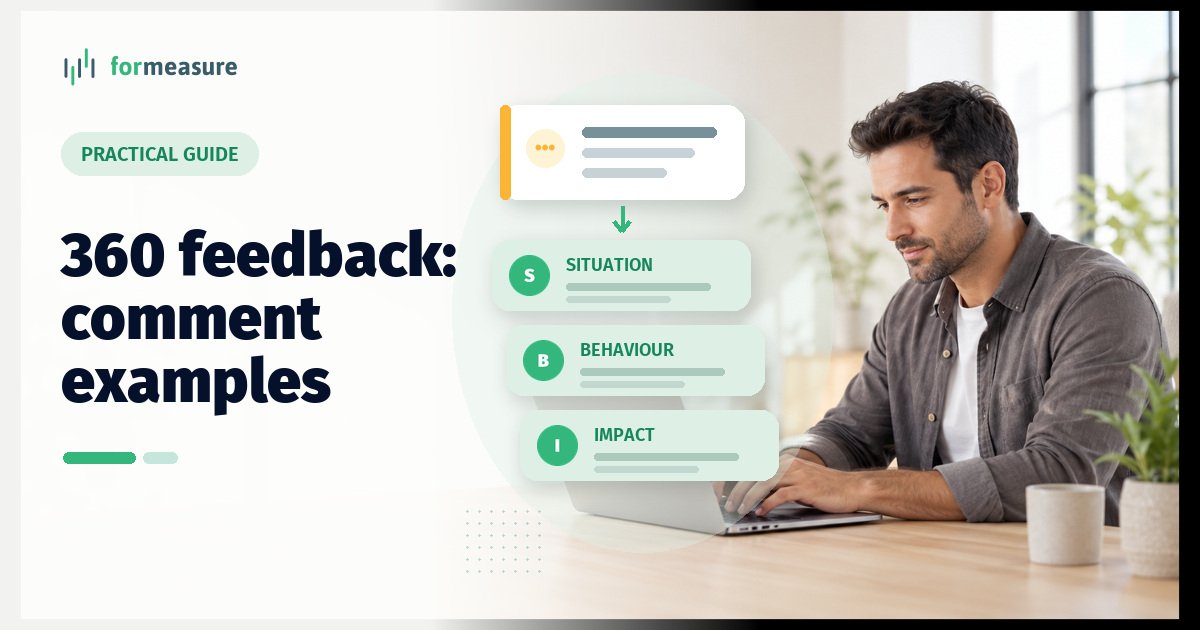
The Center for Creative Leadership offers a simple feedback model, Situation – Behavior – Impact: first name the specific situation, then describe the observable behaviour without judgements or guesses about motives, and finally say what the behaviour led to.[3] In a written 360 comment the model works just as it does in conversation, except that the writer can't check the other person's intentions, which makes sticking to facts all the more important.
| Part | What to write | Example |
|---|---|---|
| Situation | When and where it happened | "At the quarterly planning session in September…" |
| Behaviour | What the person did or said, without labels | "…Anna had collected the risks for every project in advance and suggested which tasks to move…" |
| Impact | What changed for the work, the team or you | "…and for the first time we finished planning in one meeting without rewriting deadlines a week later." |
A three-part comment takes two or three sentences, and that's usually enough for one point. If you want to cover several things, it's better to pick one strength and one development area than to list everything you can remember from the past year.
In formeasure, a 360 review runs as one cycle for the employee, their manager, peers and direct reports, the questionnaire can be set up around your company's competency framework, and the individual development report is put together automatically when the cycle closes. You can read more about it on the 360 feedback page in formeasure.
A colleague's strengths: positive feedback examples
Positive feedback in a 360 review is usually written in a single line: "great job", "excellent specialist", "always helpful". Comments like these are nice to read, but they don't tell the person what exactly is working or what to keep doing, so a strength is best described with the same situation, behaviour and impact structure. The left column of the table shows vague phrasings, and the right column shows the same ideas written out specifically.
| Strength | Vague phrasing | Specific phrasing |
|---|---|---|
| Helping colleagues | "Always ready to help" | "When I was getting to grips with the new reporting system in August, Ian spent half an hour showing me where to pull the data, and I haven't been late with the weekly report since" |
| Quality of work | "Very responsible" | "In the last three releases Emma checked the payment flows herself before deployment, and we didn't have to roll back a single change" |
| Initiative | "Proactive" | "When customers started complaining about slow replies, Paul collected the ticket statistics on his own and proposed templates for common questions, after which response times dropped noticeably" |
| Working with clients | "Good with clients" | "In a difficult client meeting in September, Mary worked through every complaint point by point and agreed a new deadline that suited both sides" |
| Mentoring | "Helps newcomers" | "Our new analyst never went a week without answers in his first month, because Dennis went through his questions with him every Friday" |
The specific phrasings have one thing in common: you can recognise the situation, and it's clear which behaviour the person should repeat. A colleague's strengths deserve the same detail as their development areas, because without them the report turns into a list of shortcomings.
Areas for improvement: constructive feedback examples
An area for improvement is easiest to describe as the gap between what happened and what would help next time. Constructive feedback in a 360 comment has three parts: what specifically happened, what it led to and what would have made the work easier. The examples below contain no verdict on the person's character, so the reader doesn't have to defend themselves against a label and can agree or disagree with the description on its merits.
| Area for improvement | Vague phrasing | Specific phrasing |
|---|---|---|
| Deadlines | "Often misses deadlines" | "In October the designs for two landing pages arrived a week later than agreed, and development had to shift the sprint; it would have helped to hear about the delay in advance" |
| Discussions | "Doesn't listen" | "At retrospectives Sam interrupted colleagues several times before they'd finished, and after that the junior developers almost stopped making suggestions" |
| Handovers | "Keeps everything in her head" | "When Kate went on holiday, the team spent two days looking for the ad account logins; a short handover note before the holiday would have kept work moving" |
| Preparing for meetings | "Comes unprepared" | "In the last two meetings with the sales team, the funnel figures only appeared during the discussion, and the decision was pushed to the following week" |
| Responsiveness | "Hard to reach" | "Questions about urgent tasks in the team chat sometimes get an answer the next day, and I end up having to escalate them to our manager" |
One or two areas for improvement per comment are enough. If more have built up, pick the ones that affect the shared work most and raise the rest in an ordinary working conversation.
Feedback for your manager: comment examples
A comment for a manager needs one more check, because a manager usually has only a few direct reports and the author is easier to identify from the details. The Public Service Commission of Canada requires at least three responses in the peer and direct report categories to protect anonymity,[4] but even in such a group, mentioning a project only you worked on gives you away more reliably than a signature would. Where anonymity breaks down in practice is covered in our article on anonymous employee surveys.
| Topic | Vague phrasing | Specific phrasing without identifying details |
|---|---|---|
| Strength: support | "Good manager" | "When the team is up against a deadline, our manager negotiates with neighbouring departments to postpone secondary tasks, so we can focus on what matters most" |
| Development area: priorities | "Keeps changing tasks" | "Over the last quarter, priorities on current work changed mid-sprint at least three times, and some finished work had to be shelved; it would help if the reasons were explained at the planning meeting" |
| Development area: feedback | "Doesn't give feedback" | "I more often find out that my work wasn't up to standard in a group meeting than in a one-to-one, so I don't get a chance to fix anything before it" |
| Development area: delegating | "Does everything themselves" | "Our manager usually takes the complex tasks on personally, so the team has few chances to learn how to run them independently" |
The phrasings in the second column are written so that any member of the team could have left them. If the point doesn't make sense without a specific episode, it's better to raise it with the manager in person or through HR, because an anonymous comment with a recognisable story is no longer anonymous.
Self-evaluation example for a 360 review
The open question in a self-assessment comes in different forms: "tell us about your main results", "what do you consider important about yourself", "what would you like to develop". Its purpose is the same in every case, which is to give the people reading the report some context for your scores. The 360 feedback results guide shows that the most useful part of a report is where self-ratings differ from others' ratings, and a comment about yourself helps explain where that gap comes from.
A convenient structure for such a comment includes two or three results from the period backed by facts, one development area you see yourself and the support you need for it. A manager of a small team, for example, might write: "Over the past six months the team moved to two-week sprints, and the share of tasks closed on time rose from half to three quarters. I see quickly clearing blockers with neighbouring departments as one of my strengths. I want to get better at delegating: right now I run all the negotiations with the client myself, and if I go on holiday the team loses that channel. It would help if one of the senior specialists ran some of these meetings with me next quarter." A specialist without direct reports might write something shorter: "This quarter I moved the team's reporting to an automatic export, and preparing the weekly report went from a day to an hour. I want to get more confident defending my proposals in meetings with heads of neighbouring departments, and it would help to present at one of the quarterly meetings together with my manager." The figures in both examples are hypothetical, and in a real self-evaluation it's better to rely on your own data, even if it's more modest.
Self-assessments often end up at one of two extremes: a report on achievements without a single difficulty, or a list of shortcomings meant to show self-awareness. Both get in the way of a development conversation, whereas a combination of a concrete result and an honestly named development area shows that the person sees their work clearly.
What to leave out of a comment
The first group of phrasings to avoid is about personality: "lazy", "toxic", "not a team player". Words like these state the writer's conclusion without showing what it's based on, and according to Kluger and DeNisi, feedback aimed at the person works worse than feedback about the task.[2] Guesses about motives, such as "does it to get noticed by management", belong to the same group, since the writer has no way of checking them.
The second group covers things the writer only knows second-hand, comparisons with other colleagues and topics outside work such as health, family or appearance. Comments like these don't help anyone change how they work, and they can sting more than any low score. Finally, long lists of grievances, even accurate ones, were linked to declining ratings in Smither and Walker's study,[1] so one or two main points work better than ten.
How to phrase the open questions in the questionnaire
The quality of comments depends a lot on how HR words the open questions. A generic "any comments?" usually collects short brush-offs, while a question tied to behaviour tells people what to write about. Two or three open questions are enough for most questionnaires, for example: "What should this person keep doing in their work with you?", "What one change in their work would help you most?" and "Give an example of a situation that explains your rating". The general rules for building the questionnaire, including choosing competencies and a scale, are covered in our overview of 360-degree feedback.
Before launch it's worth briefly explaining to participants how to write comments and showing them one example of a specific phrasing. The hint takes a couple of lines in the invitation, but it noticeably changes what ends up in the report.
Limitations
The examples in this article are hypothetical, and their wording needs adapting to your company's culture and competency framework. Smither and Walker's study looked at managers rated by their direct reports, so applying its findings to peer ratings and self-assessments is a reasonable assumption that the study itself didn't test. The situation, behaviour, impact model gives feedback a convenient structure, but it doesn't guarantee that a comment won't hurt, and the tone still depends on the writer.
360 feedback in formeasure
In formeasure, a 360 cycle combines the self-rating with ratings from the manager, peers and direct reports, lets you set up the competency framework your company uses and choose anonymous or open mode. The individual development report is put together automatically, and how to read it together with the comments is covered in detail in the guide to 360 feedback results.
Frequently asked questions about 360 feedback examples
What should you write in a 360 comment for a peer?
Describe one specific situation, what your colleague did and what it led to. The same structure works for a strength and for a development area, and two or three sentences are usually enough.
How do you write positive feedback for a colleague?
Describe a specific situation in which your colleague helped or did good work, and what it changed for you or the team. For example, instead of "always ready to help", say what exactly they helped with and what came of it.
Which areas for improvement should you mention in a 360 review?
Choose one or two areas that affect the shared work most, such as deadlines, preparing for meetings, handovers or responsiveness. For each one, describe the case, its consequences and what would help next time.
How do you write a critical comment in a 360 review?
Describe the behaviour and its consequences without judging the person's character, and add what would help in future. For example, instead of "misses deadlines", say which deadline slipped, what happened as a result and how it would be easier to work together.
What should you write about yourself in a 360 review?
Name two or three results from the period with facts, one development area you see yourself and the support you need to develop it. A comment like this helps readers of the report understand where the gap between your self-rating and others' ratings comes from.
How long should a 360 feedback comment be?
Two or three sentences are usually enough for one point: the situation, the behaviour and the impact. A long list of remarks works worse, so it's better to choose one strength and one development area.
Can people find out who left a comment?
In anonymous mode the authors' names aren't shown, but an author can still be identified from the details, especially in a small group. That's why a comment for your manager shouldn't mention projects or episodes that only you know about.
How many open questions should a 360 questionnaire include?
Two or three open questions tied to behaviour are enough for most questionnaires: what the person should keep doing, what they should change and which example explains the rating.
What shouldn't you write in a 360 review?
Leave out labels about personality, guesses about motives, second-hand information, comparisons with other colleagues and topics outside work. Comments like these don't help anyone change how they work and can hurt more than a low score.
Sources
- Smither J. W., Walker A. G. — Are the characteristics of narrative comments related to improvement in multirater feedback ratings over time? // Journal of Applied Psychology. 2004. Vol. 89, No. 3. P. 575–581. https://doi.org/10.1037/0021-9010.89.3.575
- Kluger A. N., DeNisi A. — The effects of feedback interventions on performance: A historical review, a meta-analysis, and a preliminary feedback intervention theory // Psychological Bulletin. 1996. Vol. 119, No. 2. P. 254–284. https://doi.org/10.1037/0033-2909.119.2.254
- Center for Creative Leadership — Use Situation-Behavior-Impact (SBI) To Understand Intent. https://www.ccl.org/articles/leading-effectively-articles/closing-the-gap-between-intent-vs-impact-sbii/
- Public Service Commission of Canada — 360° Feedback Services: Frequently Asked Questions. https://www.canada.ca/en/public-service-commission/services/staffing-assessment-tools-resources/human-resources-specialists-hiring-managers/human-resources-toolbox/personnel-psychology-centre/assessment-counselling-services/360-feedback-instruments-services/360-feedback-services-frequently-asked-questions.html