
There are two ways to find out why someone left: ask them in their last days at work, or write to them once they've spent a few months somewhere else. Back in 1969, Lefkowitz and Katz compared the answers people gave through these two routes and found that they barely lined up: in the exit interview, people tended to name reasons that were comfortable to say out loud and kept quiet about whatever reflected badly on the company.[1] The finding has been repeated many times since, and yet exit interviews are still one of the most common HR practices.
I'll work through the topic with a hypothetical case. In a sales team of fourteen, four people resigned within five months, and in their exit conversations with the sales manager, Owen, three said they'd received an offer with better pay while the fourth mentioned a move to another city. Owen concludes that the company's pay has fallen behind the market, but HR manager Hannah notices that all four left shortly after the team's largest clients were reassigned, and she wants to know which explanation is closer to the truth.
What is an exit interview?
An exit interview is a conversation or questionnaire in which a company asks a departing employee why they're leaving and how they see the work, management and conditions. Everett Spain and Boris Groysberg describe a range of formats, from a face-to-face conversation to a questionnaire or a combination of both. In their view, many exit interview programs fail to deliver because of poor data quality and a lack of consensus on how to run them well.[9]
Cornelius König, Manuela Richter and Isabela Isak show what this looks like in practice. Of the 164 German employees they surveyed who had resigned from a job, 67, or 41%, had an exit interview. In 81% of cases it was held by the direct manager, roughly six times out of ten it took place on the last or second-to-last working day, and it lasted about 26 minutes on average.[4] In the sales team case the format is exactly that: a conversation with Owen in the final days, after which a single line with the reason appears in the employee's file.
Why exit interview answers differ from the real reasons
The study by Lefkowitz and Katz started a whole line of research. As König and colleagues summarize it, departing employees held back information and opinions and shifted their stated reasons toward what sounded socially acceptable, and other researchers in the US and elsewhere later found similar distortions.[1][4] Richard Feinberg and Nina Jeppeson repeated the comparison with data from a large US department store retailer: former employees received a mailed survey with the same list of reasons used in the exit interview, and once again the answers diverged.[2]
The authors add a caveat worth keeping in mind: a gap shows that one of the two sources is inaccurate, but it doesn't say which one. A delayed survey can suffer because people reinterpret their story over time, and the reason an HR officer recorded right after the conversation is sometimes closer to the truth.[2] For HR, this means the job is to compare several sources rather than to search for a single "honest" channel.
Why people hold back is explained by the work of Robert Giacalone and colleagues. They identified three groups of motives that push departing employees toward honesty and three that discourage it, and the latter include fear of negative consequences, personal and situational reasons, and doubts about the objectivity of whoever is asking.[3] In the case, that means a salesperson who's counting on a good reference and may well run into Owen at an industry event finds it easier to mention pay than to talk about the manager's decisions on clients.
An exit questionnaire that doesn't go through the manager is easy to build in the formeasure survey builder, and you can try the service for free in a demo workspace on the surveys page.
You can run a survey like this with your own team right away in a free formeasure demo workspace.
Why run exit interviews if the answers are inaccurate?
König and colleagues suggest seeing the exit conversation as a signal the company sends to the person who's leaving. Participants who'd had one rated their residual commitment to the former employer at 2.93 out of 5 on average, against 2.37 for those who hadn't, and were less willing to complain about the company to friends (2.03 against 2.30). The link was explained by how fairly and respectfully people felt they'd been treated during the parting.[4] The study is correlational and cross-sectional, so it can't prove that the conversation itself causes these differences, and the authors say so plainly.
Carol Kulik and colleagues interviewed people who had recently resigned and described two patterns. Those who left for external reasons, to go back to study for example, spoke to their manager directly, met with understanding and stayed interested in a relationship with the company afterwards. Those who left because of problems inside the organization went through several rounds of hints before stating their decision outright, while managers missed the moment and sometimes provoked a wish to get even, which the authors called a "vendetta effect".[5] Hence their advice to train managers in exit conversations, especially with people leaving for internal reasons.
Taken together, these studies show that an exit interview has two separate jobs. The first is about the relationship: a departing employee may come back, refer a candidate or a client, or tell friends nothing but bad things about the company. The second is about data on why people leave, and a single conversation with the manager is the least suited tool for it. Spain and Groysberg give an example of a department of seventeen where only eight people remained after a year, and only comparing several exit interviews revealed that the company was systematically promoting people to management for technical rather than managerial skill.[9] The useful signal appeared only when the answers of several leavers were put together and read as one dataset.
Who should conduct the exit interview, and when?
The choice of who asks the questions decides which of the two jobs the interview does.
| Who conducts it | What it gives | Limitation |
|---|---|---|
| Line manager | Relationship, thanks, handover agreements | Uncomfortable reasons rarely come up |
| HR | One question set, comparable data | Still a conversation with the company |
| Third party or questionnaire | More candor about the manager and decisions | No conversation, few answers in small teams |
| Follow-up survey after 1–3 months | Reasons without last-day pressure | Only some former employees respond |
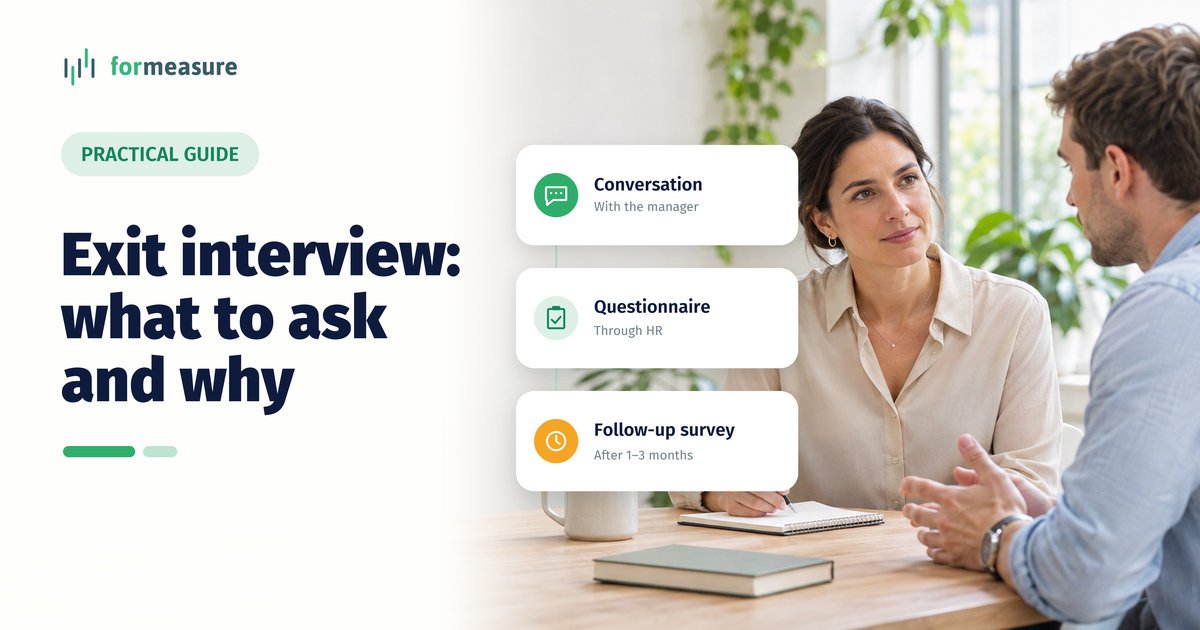
The working approach we suggest, based on this research, has three steps: a manager's conversation about thanks and the future, a short HR questionnaire about reasons and, where possible, a follow-up questionnaire one to three months after the person has left. Research doesn't prescribe the timing of the follow-up; it's our practical assumption, chosen because by then the person no longer depends on a reference and still remembers what happened. In the case, Hannah can leave Owen the conversation about thanks and client handover and ask about the reasons herself through the questionnaire.
It's worth being honest with leavers about anonymity: if two people left a team in a quarter, an exit questionnaire can't really be called anonymous even without a name field, so what you can promise is confidentiality, explaining up front who will see the answers and in what form. The difference between the two promises is covered in detail in our article on anonymous employee surveys.
Exit interview questions
It helps to group the questions into blocks so the conversation moves from the decision to leave toward what the company could change. Below are questions for the conversation and the questionnaire, grouped by topic.
- The decision
- When the thought of leaving appeared and what triggered itQuestions: When did you first seriously think about leaving? What happened at that time? What finally convinced you to go?
- The work
- Tasks, workload, resourcesQuestions: What did you enjoy most about the work? What got in the way of doing it well? How did your workload change over the last six months?
- Manager and team
- Support, feedback, decisions that affected the employeeQuestions: How well did you understand why decisions about your work were made? Did you get feedback when you needed it?
- Growth and pay
- Career prospects and comparison with the new offerQuestions: Could you see where you might grow in the company? What made the difference in the new offer?
- What to change
- Suggestions that can be passed onQuestions: What could have kept you if it had changed six months ago? What would you advise the company to change for the people who stay?
- After leaving
- Willingness to return and recommendQuestions: Would you consider coming back in a year or two? Would you recommend the company to a friend?
The first block draws on the unfolding model of Thomas Lee and Terence Mitchell, in which leaving often begins with a "shock", a noticeable event after which a person first thinks about quitting.[7] Kulik, Treuren and Bordia used this model to classify exit interview data and showed that such events can be work-related or personal, and that sometimes it takes a combination of a push and a pull to make someone leave. For employees who have been unhappy for a long time, a "final straw" takes the place of a shock and merely confirms a decision that has already formed.[6] That's why "When did you first think about leaving?" tells you more than "Why are you leaving?", which tends to draw out the final straw, such as the higher salary in the new offer.
For a questionnaire, these blocks can become eight to ten statements on an agreement scale plus two or three open questions, while the conversation keeps the open questions and leaves pauses in which the person can say more than they were asked.
How to analyze exit interviews
A single conversation proves almost nothing, so answers should be pulled together at least once a quarter, or every six months in smaller companies. It helps to code the reasons into a few themes, such as the work, the manager, growth, pay and personal circumstances, and to note separately which event the person named as the start of their thinking about leaving. When several people in one team name the same event, that stands out more than any average score.
It also pays to compare exit answers with what employees said before they left. If a team had low fairness ratings in an employee satisfaction survey or signs of cynicism in a burnout survey, but leavers mention nothing except pay, the gap says a lot. In the case, Hannah sent the four former employees a short questionnaire two months after they left and got three replies. Two of the three named the client reassignment, which nobody had explained to them, as the starting point of their thinking about leaving, and mentioned pay as the reason they accepted a particular offer. Three replies don't prove anything, but they give Hannah a specific question to discuss with Owen about how decisions are explained in the team.
People who stay need to see that the leavers' answers led somewhere, or the next ones to leave won't open up. One or two changes that the manager presents to the team as a response to feedback do more for trust than a detailed report.
Common exit interview mistakes
The most common mistake is to hand the only conversation to the line manager and then treat its answers as a diagnosis. The manager is well placed to talk about thanks and handover, but they're the person least likely to hear that someone is leaving because of their decisions.
The second mistake is promising anonymity that can't be delivered: in a small team, the person leaving knows their answer is easy to identify, so they either write generalities or stop trusting future surveys. It's more honest to explain who will see the answers and to show managers only a summary for the period.
The third mistake is collecting answers without analyzing them, because exit interviews that nobody summarizes and that change nothing waste leavers' time and tell the people who stay that their opinion doesn't matter. Finally, an exit conversation is no substitute for talking to people who are still there: regular pulse surveys show a problem before it turns into a string of resignations.
Limitations of exit interviews
Even a well-run exit interview explains why particular people left and says nothing about those who are thinking of leaving but stay. Answers lean toward acceptable reasons, follow-up surveys reach only some former employees, and in small teams any department-level numbers are unstable. The König study behind the relationship argument used a small German sample with an average age of about 30, and results may differ in countries where the gap between resignation and the last working day is short.[4] The resignation style taxonomy by Anthony Klotz and Mark Bolino that this study builds on was also tested on limited samples.[8]
Exit interviews in formeasure
In formeasure, you can build an exit questionnaire in the survey builder, send the departing employee a link and review answers in a summary by department, where groups with too few responses are combined so no individual can be identified. A follow-up for former employees works well as an open survey shared by link, and reasons for leaving can be compared with the results of regular engagement and satisfaction surveys in the same teams.
If you run exit interviews, tell us on the formeasure LinkedIn page which question most often got you a candid answer. With the authors' consent, we'll add the best questions to this article and credit them by name.
Frequently asked questions about exit interviews
What is an exit interview?
It's a conversation or questionnaire with an employee who is leaving, covering why they're leaving, their experience at the company and what should change.
Who should conduct an exit interview?
The manager is best placed for the conversation about thanks, handover and a possible return, while questions about reasons for leaving are more reliably asked through HR, a third party or a questionnaire whose answers don't go straight to the manager.
What questions should you ask in an exit interview?
Ask when the person first thought about leaving and what happened then, what got in the way of their work, how they rate the manager's support, whether they saw room to grow, what made the difference in the new offer, and what the company should change for those who stay.
Why don't employees tell the truth in exit interviews?
They worry about their reference and relationships, don't believe their answer will change anything, or name the final straw instead of the event that first started them thinking about leaving. Studies comparing exit interviews with surveys a few months later found weak agreement between the reasons given.
When is the best time to hold an exit interview?
The conversation usually happens in the last days of work, and it's useful to repeat the questionnaire about reasons one to three months after the person has left, when they no longer depend on a reference and still remember the circumstances; this timing isn't set by research and comes from practice.
Can an exit survey be anonymous?
In small teams full anonymity isn't possible, because only one or two people leave in a given period. It's more honest to promise confidentiality: explain who will see the answers and show managers only a quarterly or half-yearly summary.
How do you analyze exit interview results?
Pull answers together by quarter or half-year, code the reasons by theme, note the event that first started the thought of leaving, and compare the results with engagement and satisfaction surveys of the same team before people left.
Are exit interviews mandatory?
Employment law usually doesn't require them, and employees can decline. They're worth doing if the company is ready to summarize the answers and act on them; otherwise the conversation becomes a formality.
Sources
- Lefkowitz J., Katz M. L. — Validity of exit interviews // Personnel Psychology. 1969. Vol. 22, № 4. P. 445–455. https://doi.org/10.1111/j.1744-6570.1969.tb00345.x
- Feinberg R. A., Jeppeson N. — Validity of exit interviews in retailing // Journal of Retailing and Consumer Services. 2000. Vol. 7, № 3. P. 123–127. https://doi.org/10.1016/S0969-6989(99)00009-0
- Giacalone R. A., Knouse S. B., Montagliani A. — Motivation for and prevention of honest responding in exit interviews and surveys // The Journal of Psychology. 1997. Vol. 131, № 4. P. 438–448. https://doi.org/10.1080/00223989709603531
- König C. J., Richter M., Isak I. — Exit interviews as a tool to reduce parting employees’ complaints about their former employer and to ensure residual commitment // Management Research Review. 2022. Vol. 45, № 3. P. 381–397. https://doi.org/10.1108/MRR-02-2021-0148
- Kulik C. T., Rae B., Sardeshmukh S. R., Perera S. — Can we still be friends? The role of exit conversations in facilitating post-exit relationships // Human Resource Management. 2015. Vol. 54, № 6. P. 893–912. https://doi.org/10.1002/hrm.21642
- Kulik C. T., Treuren G., Bordia P. — Shocks and final straws: Using exit-interview data to examine the unfolding model’s decision paths // Human Resource Management. 2012. Vol. 51, № 1. P. 25–46. https://doi.org/10.1002/hrm.20466
- Lee T. W., Mitchell T. R. — An alternative approach: The unfolding model of voluntary employee turnover // Academy of Management Review. 1994. Vol. 19, № 1. P. 51–89. https://doi.org/10.2307/258835
- Klotz A. C., Bolino M. C. — Saying goodbye: The nature, causes, and consequences of employee resignation styles // Journal of Applied Psychology. 2016. Vol. 101, № 10. P. 1386–1404. https://doi.org/10.1037/apl0000135
- Spain E., Groysberg B. — Making exit interviews count // Harvard Business Review. 2016. Vol. 94, № 4. P. 88–95. https://hbr.org/2016/04/making-exit-interviews-count