
"Motivation is down, let's do something about it." In that sentence motivation means a mood you lift with a bonus, a contest or a team offsite. In Vladimir Gerchikov's typological model the word means something else: a stable preference about what a person wants to get out of work. That preference barely moves when you hand out a one-off bonus, and it decides which jobs someone will do at full strength and which ones they'll do strictly by the book.
That's where the practical value sits. The model doesn't answer "how do we motivate them", it answers "who belongs where": who suits commission pay, who shouldn't be placed in an autonomous role with no support, and who'll take recognition as an insult.
The model has been popular in Russian-speaking HR for twenty years, and plenty of oversimplification has stuck to it along the way. So what follows covers both the parts research confirmed and the parts where the recommendations didn't hold.
What Gerchikov's typological model is
The model was built by sociologist Vladimir Gerchikov (1938–2007), a professor at HSE University. Of his 230-plus publications, this is the one that stuck in practice, along with the Motype questionnaire.[1][6] In 2016 HSE established a scholarship in his name.[1]
It rests on a simple distinction. Some people work to get something; others work so as not to lose anything. Gerchikov calls the first achievement motivation and the second avoidance motivation.[5]
For a manager the difference plays out like this. Someone with achievement motivation is limited only by the job itself: give them the conditions and they'll grow into them. Someone with avoidance motivation runs into the quota for the task and into the question of whether their manager can prove they failed it. Above the quota they won't go, however hard you push.
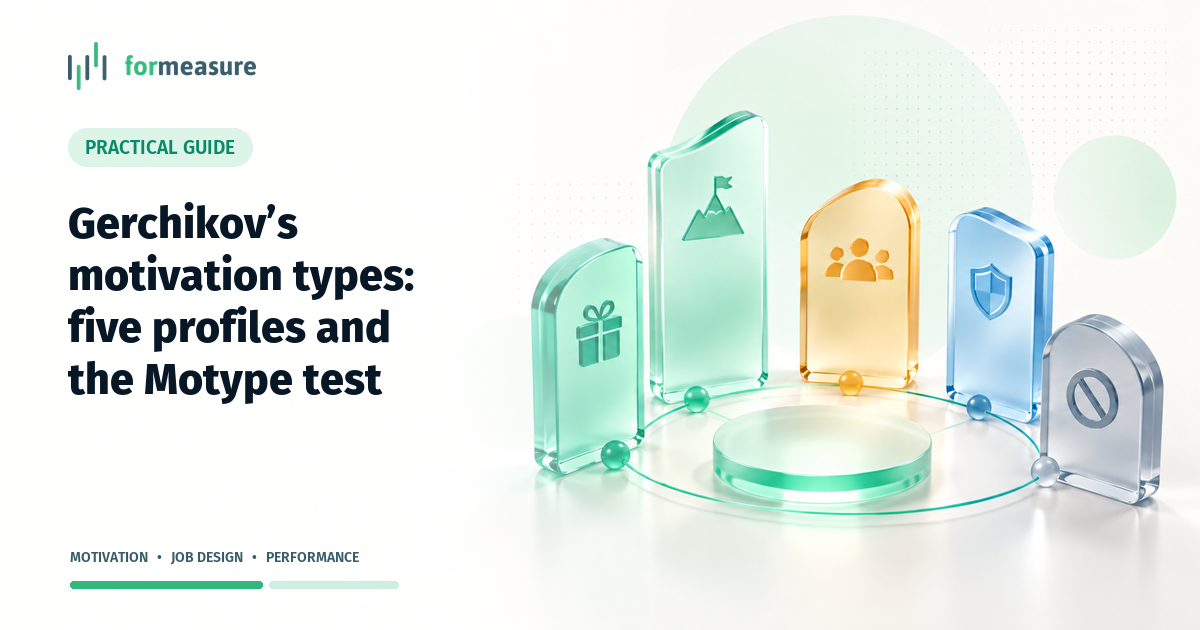
Four types belong to achievement motivation, one to avoidance.
The five motivation types
The descriptions below follow the model's own wording.[2][5] Keep in mind that any one person shows several types at once, so it's more accurate to speak of a motivation structure in which one type dominates.
Instrumental
Work holds no value in itself for this person and serves as a source of earnings. What interests them isn't money in general but earned money: the link between their own effort and the sum. They'll give any job everything they have, provided the pay is fair and high as they see it.
Offer them worse working conditions and they'll take it calmly, because that's grounds to ask for more. Offer them training at the company's expense and the answer sounds roughly like this:[5]
"I don't have time for your training, I need to earn. And don't tempt me with a raise afterwards: who knows when that happens, or whether it happens at all."
Professional
Values the content of the work and the chance to prove, to themselves as much as to anyone else, that they can handle a task not everyone could. Prefers autonomy, carries a developed sense of professional dignity, and treats the boss with a certain irony. Usually becomes the strongest specialist on their kind of job fairly quickly.
Relations with colleagues can get tense, for an understandable reason: they demand of others what they demand of themselves.[5]
"They won't move a single brain cell themselves, but they're at my desk every half hour."
One more trait makes deadlines harder. This person would rather deliver late and good than on time and mediocre.
Patriotic
What matters to them is taking part in a shared effort they consider important, and having that part acknowledged. They'll shoulder extra responsibility for a collective result, and they value a public mention more than a payment.
This is the person who picks up the task nobody else wanted, provided someone explained why the company needs it. And the person who takes it badly when the result gets celebrated and their share in it goes unmentioned.
Proprietary
Voluntarily takes full responsibility for their work. Does it at full strength without demanding that it be especially interesting or especially well paid, and without needing extra instructions or supervision. Measured by output against effort this is the most effective type, and the hardest to manage: an owner is sovereign and won't tolerate orders.
You can spot them by one habit. They quietly redraw their own patch of work so they depend on neighbouring teams as little as possible.[5] They'll absorb an adjacent function, rewrite the approval sequence, stop waiting for someone else's answer and just do it.
Avoidance (lumpenized)
Weakly motivated toward results, not interested in raising their qualifications, avoids personal responsibility. The goal is to cut effort down to whatever the immediate manager will tolerate.
They're convenient, though. They'll take the work everyone else refused. They'll accept modest pay as long as nobody nearby earns noticeably more, which is why a colleague's bonus stings far more than the size of their own salary. And they take the administrative management style that drives the other types up the wall entirely in their stride.
This last type deserves a note. The word "lumpenized" sounds like a verdict on a person, when it describes a motivation structure under particular circumstances.
The research on the model includes a telling case. A brigade of inspectors at a glass plant: monotonous work, output norms the group had settled on years earlier, and a sorter's wage of roughly two thousand roubles at the time of the survey. Avoidance there had become universal.[4] The working conditions explain it, not the character of the people.
The Gerchikov test (Motype): how it works and what it shows
Motype is a 23-item multiple-choice questionnaire that measures how pronounced each of the five types is. Version 4.1, the one used in the research, was built in 1999 by Gerchikov together with O. Lazutina and N. Grishko.[4]
What comes out is a profile of five values. So "we've got three instrumentals and two professionals in that team" names the dominant type rather than describing the people exhaustively.
A sample profile for a salesperson:
| Motivation type | Score |
|---|---|
| Instrumental | 0.34 |
| Professional | 0.21 |
| Proprietary | 0.19 |
| Avoidance | 0.18 |
| Patriotic | 0.08 |
The numbers here are illustrative, but a profile like this reads as follows. For a job with a measurable result and a large variable component in pay, high instrumental motivation is an advantage. Low patriotism in autonomous work is a plus rather than a minus. Avoidance at 0.18 is worth watching if the role involves actively chasing new clients.
From there the profile gets matched against the conditions of the specific job rather than against a job title. More on that below.
What the test doesn't do. It doesn't assess personality, doesn't measure competence, and doesn't predict how comfortable someone will be in a job. Rebrov makes the point separately: a motivation type lets you forecast performance, and that's what separates it from methods describing how an employee feels.[4]
What held up under research and what didn't
Gerchikov supplied the model with detailed recommendations for selecting and placing people. He never published the empirical data behind those recommendations, neither in his core textbook nor anywhere else. Alexey Rebrov, his student, says so plainly, and then ran the check himself.[4]
The study ran for three years, from 2004 to 2007, with Gerchikov himself leading it. It covered 12 cases in 10 organizations: 413 people whose performance could be assessed, more than 600 questionnaires, 103 interviews. The geography stretched from Moscow and Oryol to Surgut, Khabarovsk and Perm. People were grouped into manual workers, sales specialists, and managers.
The performance gap between those whose motivation structure matched the conditions of their job and everyone else came to about 20%.[4]
Part of the findings confirmed the recommendations. High avoidance motivation lowered performance almost everywhere. The instrumental type gave salespeople an advantage under two conditions: the result is measurable and depends on the person, and pay is tied to that result directly and substantially. The professional type helped where the work demands high qualifications and lengthy preparation.
Two results, though, run against the recommendations.
Patriotism turns negative in autonomous work
The patriotic type is usually treated as good without qualification. In the cases covering travel-agency sales managers and sales coordinators it lowered performance. The explanation turned up in the working conditions: where someone works autonomously, often physically apart from colleagues, with no help to count on from management, an orientation toward the shared cause becomes a handicap. Rebrov notes that this effect appears nowhere in the methodological recommendations he knows of.[4]
The mirror case held up: among sales representatives who gather for a morning stand-up and work under their manager's daily eye, patriotism didn't turn negative.
Proprietary motivation hurts a manager with no budget
The proprietary type is considered the key one for managers. In two cases it did raise performance, among the heads of agricultural enterprises and of an energy company, where the owner sits far from the operation and the hired manager effectively controls a budget.
In the third case, a machine-building company, pronounced proprietary motivation turned out to be harmful. There two owners take part in day-to-day management themselves and make the financial decisions. When a manager has no governing function and is expected to carry out instructions, a drive toward autonomy gets in the way.[4]
The main conclusion changes how the model is applied
The preferred motivation type matches the conditions of the job, not the job title. That's the substantive difference between Rebrov's results and the earlier recommendations: instead of a list saying "a salesperson needs the instrumental type", you get a list of job properties under which a given type starts to affect the result.
| Conditions of the job | Which motivation helps |
|---|---|
| Result is measurable and pay depends on it directly | high instrumental |
| Work demands high qualifications and long preparation | high professional |
| Most of the work is carrying out a manager's instructions | high patriotic |
| Autonomous work with no support from colleagues or management | low patriotic |
| A separate budget for the unit or function exists | high proprietary |
| No separate budget, financial decisions go up the chain | low proprietary |
| The work requires the person to take the initiative | low avoidance |
| No initiative required, the person responds to outside signals | avoidance has no effect |
The author states the caveats to this table himself, and they're worth holding onto. The cases are small, between 23 and 81 people, and the statistical bar in the study sits lower than usual: some of the links were accepted at a level where the chance of coincidence runs as high as one in ten. So the table reads better as a direction to test in your own company than as a settled norm. Rebrov writes that the conclusions extend to the same occupations in organizations with the same working conditions, not to the labour market at large.[4]
How to reward each type
The recommendations on rewards are the part of the model with the most counterintuitive content. Gerchikov describes both what works and what's contraindicated for a given type.[5]
| Type | What works best | What's contraindicated |
|---|---|---|
| Instrumental | money | symbolic recognition, paternalism |
| Professional | work content and conditions, career and development | punishment, paternalism |
| Patriotic | public recognition | nothing (the only type paternalism suits) |
| Proprietary | a share in ownership and in decisions | punishment |
| Avoidance | negative incentives, paternalism | organizational incentives, career |
The useful column here is the right-hand one. Hand a certificate of merit to someone who's been counting their variable pay all quarter and you'll get the opposite of the intended effect: they'll read it as a refusal to pay. Pay a bonus to a "patriot" instead of naming their contribution at the all-hands and you've spent money and bought nothing.
Paternalism deserves its own note. For the avoidance type that visible care is a basic tool, for the patriotic type it fits, and for the other three it does damage: a professional and an owner both read being looked after as doubt about their independence.
Gerchikov drew these recommendations from consulting practice. No empirical check comparable to Rebrov's work has been published for the rewards part, so treat the table as a working hypothesis your company tests on itself.
Where to get the test, and why we don't publish the form
"Download Gerchikov" is one of the most common searches on the topic. The disappointing part: Motype is distributed by the Top-Management Consult group, and it's a live copyrighted instrument.[5]
The forms circulating online tend to be incomplete, with altered wording or someone else's scoring keys. A 23-item questionnaire is sensitive to phrasing, and a reassembled version measures something other than what the original measured.
The practical route is either a licensed Motype from the rights holder, or your own survey that you honestly call your own. In the second case the result can't be compared against the norms and statistics of Gerchikov's model, and that limit has to stay in view when you interpret anything. We worked through the same fork in the guide to employee satisfaction surveys: a practical template and a validated instrument solve different problems, and mixing them up is a mistake.
What to do when Motype isn't available
Start with a description of the jobs rather than with a questionnaire. The research showed that the preferred type follows from working conditions, so without that description survey results have nothing to attach to.
For each group of positions, answer five questions:
- Is the result of the work measurable, and does it depend on the person doing it?
- Is pay tied to that result directly?
- Who plans the working time, the employee or the manager?
- Does the person control a budget or resources of their own?
- Do they work alongside colleagues or on their own?
That's enough to read the table above and see which motivation structure will produce results in that job.
After that you can ask employees about preferences, not about types. What matters more to them when pay is equal, how they feel about autonomy and supervision, what they consider fair reward, under what conditions they take on extra responsibility. Questions like these are written as statements with an agreement scale and follow the same rules as any questionnaire: one statement measures one idea, with a consistent context and time frame.
And the limit that matters. What you get is a description of your own employees' preferences. Calling it a Gerchikov type, comparing it with the model's norms or dropping it into the reward tables is out: it's a different instrument, even if it borrows the same logic.
Motivation, engagement and satisfaction: what each one measures
These words stand in for each other in HR conversation while answering different questions.
Motivation in Gerchikov's sense is a stable structure of preferences: what a person wants to get from work. It's measured with a typological questionnaire, changes slowly, and predicts performance in a certain kind of job.
Satisfaction is an assessment of the current experience across separate factors: the work itself, pay, the manager, conditions. It's measured with a satisfaction survey, changes quickly, and responds to what the company does.
Engagement is involvement and energy at work. It's measured with an engagement survey and describes a state rather than a preference.
eNPS is willingness to recommend the company as an employer, one question and an index. More on it in the guide to employee net promoter score.
Hence a common management mistake. Engagement drops, and the company launches a motivation programme. The two indicators describe different things: engagement fell because of specific events in recent months, while the motivation structure hasn't moved in that time. The right move is to work out what actually dropped and only then pick the instrument. That sequence is laid out in what to do after an employee engagement survey.
Mistakes that stop the model from working
The type becomes a label
"He's a lumpen" is a convenient phrase that ends the conversation. The model describes a motivation structure under particular conditions, and that same brigade of inspectors shows how completely the conditions can reshape it.
The type gets tied to a job title instead of a job
This is exactly where the recommendations failed. "A manager needs proprietary motivation" holds where the manager has a budget and fails where they don't. Before you write a type into a role profile, describe the work: who plans the time, whether a budget exists, whether the result is measurable, whether the person works in a team or alone.
Results get used for personnel decisions
The test was built for selection and placement, not for appraisal. Once employees work out that their position or pay depends on the result, they'll answer the way they think they should, and the measurement stops meaning anything.
A survey gets called anonymous when it isn't
Rebrov's study was deliberately not anonymous, since otherwise the answers couldn't be matched against performance data. He describes how participants were told the purpose and assured that their forms wouldn't affect pay or status.[4] If you repeat that design, call the arrangement confidential and mean it. What that involves in practice is covered in the guide to anonymous employee surveys.
The profile is taken once and treated as permanent
A motivation structure shifts more slowly than a mood, but it does shift, following working conditions, life stage and experience. Repeating the measurement makes sense after a noticeable change in someone's work.
Motivation surveys in formeasure
Gerchikov's typology needs a licensed Motype from the rights holder. That's a question of rights, not of technical capability.
In formeasure you can build your own survey around a defined people question. For example, how employees see the pay system, whether they have enough autonomy, whether the conditions of a job line up with what matters to the people in it. Results are analysed by factor and by group.
This is your company's own instrument, and its results aren't compared with the norms of validated methods.
Frequently asked questions about Gerchikov's motivation types
How many motivation types did Gerchikov identify?
Five: instrumental, professional, patriotic, proprietary, and avoidance (lumpenized). The first four belong to achievement motivation, the last to avoidance motivation.[2][5]
Can one person have several types at once?
Yes, and that's the normal case. The test measures how pronounced each of the five types is, so the result is a profile in which one type dominates the rest.
What is the Motype test and how many questions does it have?
It's the questionnaire that implements the typological model. Version 4.1 contains 23 multiple-choice questions and diagnoses how pronounced each of the five types is.[4]
Can you download the Gerchikov test for free?
Motype is distributed by the Top-Management Consult group and remains a live copyrighted instrument. Copies circulating openly are often incomplete or carry altered wording and someone else's scoring keys, which makes the result stop matching the model.[5]
Has the model been confirmed by research?
Partly. Rebrov's published study of 413 people confirmed the link between motivation structure and performance along with some of the methodological recommendations, while overturning the recommendations on the patriotic and proprietary types under certain working conditions. The sample is small and isn't representative of all organizations.[4]
How does motivation differ from engagement?
Motivation in this model is a stable preference about what a person wants to get from work. Engagement describes a current state: involvement and energy. The first changes slowly, the second responds to events of recent months.
Can you decide who to hire based on motivation type?
A type tells you how well a candidate's motivation structure fits the conditions of a specific job. It doesn't measure skill, doesn't assess personality, and shouldn't be the only basis for a hiring decision.
How often should an employee's motivation profile be reviewed?
A motivation structure is stable, so frequent measurement adds nothing. Repeating the survey makes sense after a noticeable change in someone's work: a new role, a new pay system, a new work format or a different level of autonomy.
Sources
- HSE University — Vladimir Isakovich Gerchikov, university profile. https://www.hse.ru/org/persons/1233431/
- Gerchikov V. I. — The Typological Concept of Work Motivation. Part 1 // Motivatsiya i oplata truda. 2005. No. 2. P. 53–62.
- Gerchikov V. I. — The Typological Concept of Work Motivation. Part 2 // Motivatsiya i oplata truda. 2005. No. 3. P. 2–6.
- Rebrov A. V. — The Influence of Motivation Structure on the Performance of Workers in Different Occupations // Sotsiologicheskie issledovaniya. 2008. No. 5. P. 74–84. https://www.delfy.biz/library/161
- Top-Management Consult Group — V. I. Gerchikov's Typological Model of Motivation (description of the model and the reward tables from the distributor of the Motype test). https://tmconsult.ru/faq/tipologicheskaya-model-motivatsii-v-i-gerchikova.php
- Gerchikov V. I. — Personnel Management: the Employee as a Company's Most Effective Resource. Moscow: INFRA-M, 2007. 282 p.
- Rebrov A. V. — Factors Shaping the Motivation of Employees in Russian Organizations // Sotsiologicheskie issledovaniya. 2011. No. 3. P. 38–49. https://www.delfy.biz/library/167