
An employee engagement survey can produce a reassuringly precise number, 72 out of 100, while leaving HR unsure what to do next.
Two teams can have the same overall score for completely different reasons. One team understands its goals and trusts its manager but sees no path for growth. Another has strong development opportunities but receives little feedback and has limited influence over decisions. The headline number is identical; the right response is not.
That is why an overall index is only the starting point. In formeasure, we separate engagement itself from the workplace conditions that influence it.
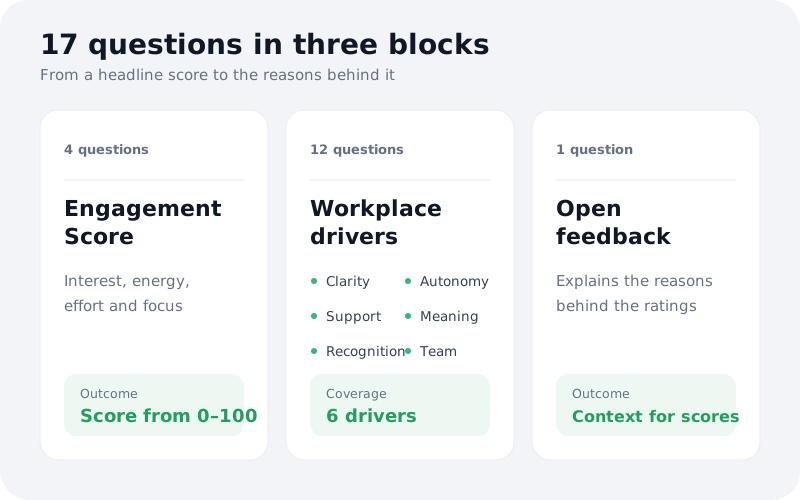
Below is a ready-to-use employee engagement survey with 17 questions, a transparent scoring formula, six workplace drivers, and a worked example showing how a People team can move from results to action.
What employee engagement means in this survey
Employee engagement is easy to confuse with job satisfaction or loyalty. The concepts overlap, but they answer different questions.
Someone can be satisfied with their pay, schedule, and colleagues while doing the work on autopilot. The reverse is also possible: an employee can be deeply absorbed in the work and committed to the team while disagreeing with some company decisions.
CIPD distinguishes employee engagement from related concepts such as motivation and organizational commitment.[1] Motivation stands apart in that list: it describes a person's stable preferences about what they want to get from work, and it shifts far more slowly than engagement does. The guide to Gerchikov's motivation types covers it. Gallup likewise separates overall engagement from workplace conditions such as clear expectations, resources, development, and connection to purpose.[2]
For a practical survey, it helps to separate:
- engagement itself: interest, energy, focus, and willingness to put effort into the work;
- the environment around the work: role clarity, resources, manager support, feedback, recognition, development, autonomy, meaning, and teamwork.
If the overall score changes, this structure helps you see which workplace drivers moved with it.
17 employee engagement survey questions
Use the same five-point agreement scale for questions 1–16:
1 — Strongly disagree
2 — Disagree
3 — Neither agree nor disagree
4 — Agree
5 — Strongly agree
A consistent scale makes the survey easier to complete and the results easier to compare. Keep each statement short and focused on one idea. “My manager supports me and gives useful feedback,” for example, combines two topics and makes the response difficult to interpret. Pew Research Center recommends avoiding this kind of double-barreled question.[3]
Questions 1–4: engagement
The first four questions focus on how an employee experiences the work itself. Manager support, development, and resources are measured separately.
1. During the working day, I can usually stay interested in my tasks.
2. On most working days, I have enough energy to work at a steady pace.
3. When a task calls for extra effort, I am usually willing to put it in.
4. When I am working, I can often focus deeply and become fully absorbed in the task.
These four responses are used to calculate the Engagement Score. The remaining questions provide the context needed to interpret it.
Questions 5–6: role clarity and resources
5. I understand what results are expected of me in my role.
6. I have the tools, information, and access I need to do my work well.
Low scores here do not prove weak motivation. Constantly changing priorities, instructions from several managers, or missing information and access can produce the same result.
Questions 7–8: manager support and feedback
7. When I run into a work problem, I can rely on my manager for support.
8. Feedback from my manager helps me improve my work.
Support and feedback are not the same. A manager can be approachable and helpful while rarely discussing the quality of an employee’s work. Those are different signals for a People team, so they belong in separate questions.
Questions 9–10: recognition and development
9. When I do good work, it is noticed.
10. I have real opportunities to develop my professional skills at work.
The first question asks whether good work receives a visible response. The second asks whether the employee feels they are continuing to grow. A low score does not automatically call for a new bonus scheme or career framework. Sometimes good work is rarely acknowledged, or growth opportunities exist but are not clear.
Questions 11–12: autonomy and employee voice
11. I have enough freedom to decide how to do my work.
12. My suggestions for improving how we work are taken seriously.
Even in a strong team, an employee can feel like an executor rather than a contributor. This is common in organizations that ask for initiative while requiring a long approval chain for small changes. CIPD identifies autonomy as one of the factors associated with motivation and engagement.[1]
Questions 13–14: meaning and connection to results
13. I understand how my work contributes to the results of my team or company.
14. The work I do feels meaningful to me.
An employee can understand the business value of a task without finding it personally meaningful. The reverse can happen too, which is why these ideas should not be combined.
Questions 15–16: team and trust
15. In my team, people can speak openly about work problems and mistakes.
16. I can rely on my colleagues when my work depends on them.
These questions look at two sides of teamwork: whether difficult issues can be raised openly and whether agreements between colleagues hold up in practice.
Question 17: open feedback
17. If you could change one thing about your work or the company that would help you work better, what would it be?
The open question provides context that a rating scale cannot. A low development score can reflect a missing career path, a lack of challenging work, or poor communication about existing opportunities. One focused open question adds that context without turning a short survey into a long interview.
How to run an employee engagement survey
A good questionnaire is only part of the job. Before launch, agree on what the organization wants to learn, who will review the results, and which decisions leaders are genuinely prepared to make once the answers arrive.
- Define the purpose. Decide whether you need a company-wide baseline, a comparison between teams, or evidence about a recent change. The purpose determines which questions belong in the survey and which report cuts will be useful.
- Prepare the questionnaire. Use one clear response scale, remove double-barreled statements, and test the wording with a small group. The template in this guide is a practical starting point, but team names and explanatory notes should sound natural inside your organization.
- Protect anonymity. Set a minimum reporting group size before collecting responses, and avoid combining filters that could identify an individual. If the survey is confidential rather than anonymous, explain that distinction plainly.
- Tell employees what happens next. The invitation should state the purpose, closing date, confidentiality rules, and when people will hear about the results. A specific commitment is more credible than a long message about the value of feedback.
- Review the answers and assign follow-up. Start with the overall score, then examine the workplace drivers, team differences, response distributions, and open comments. Choose one or two themes for discussion, name an owner, and publish the next step.
Before sending the survey, run one final check: every question should lead to either a useful interpretation or a possible management action. If nobody plans to use the answer, remove the question.
How often should you run an employee engagement survey?
For many organizations, a full survey every six or twelve months is a sensible baseline. A six-month cycle works better when teams, leadership, or operating processes are changing quickly. In a more stable organization, an annual survey may provide enough signal without creating survey fatigue.
Between full surveys, use short pulse surveys to check one topic. After changing how managers give feedback, for example, repeat the manager-support questions rather than sending all 17 again. The right cadence is one the organization can support with analysis, action, and a visible response to employees.
How to calculate the Employee Engagement Score
Only questions 1–4 are included in the Engagement Score. First calculate the average response, then convert the 1–5 scale into a score from 0 to 100:
Formula
Engagement Score = (average of Q1–Q4 − 1) / 4 × 100
For example, if the average across the four questions is 3.88:
(3.88 − 1) / 4 × 100 = 72
The Engagement Score is 72 out of 100. Do not treat 72 as a universal boundary between “good” and “bad.” A better comparison is the organization with itself: track changes over time, differences between teams, and movement after specific actions.
How to score the six engagement drivers
Questions 5–16 form six pairs. Calculate a separate 0–100 score for each pair using the same conversion formula.
| Workplace driver | Questions |
|---|---|
| Role clarity and resources | 5–6 |
| Manager support and feedback | 7–8 |
| Recognition and development | 9–10 |
| Autonomy and employee voice | 11–12 |
| Meaning and connection to results | 13–14 |
| Team and trust | 15–16 |
Worked example: from a score to two actions
Illustrative example
Maya leads People Operations at a 120-person software company. Her latest engagement survey produces an overall score of 72 out of 100. Nothing looks alarming at first. The picture changes when she opens the driver scores.
| Measure | Score |
|---|---|
| Engagement Score | 72 |
| Role clarity and resources | 84 |
| Manager support and feedback | 67 |
| Recognition and development | 48 |
| Autonomy and employee voice | 55 |
| Meaning and connection to results | 81 |
| Team and trust | 76 |
Recognition and development is the weakest area. When Maya compares teams, the engineering score is especially low. Several open-text comments point to the same issue: the work is interesting, but people do not know what progression looks like or what is expected at the next level.
Autonomy is the second weak area. Another theme appears in the comments: even small process changes require several layers of approval.
Maya does not launch five People initiatives at once. She works with the engineering leader on two concrete changes: document expectations for each level and identify decisions the team can make without additional approval.
Three months later, she reruns only the relevant sections. If the scores move, the team can compare the change with the actions taken. If they do not, Maya knows the issue needs deeper investigation.
Want to run this survey with your team?
In formeasure, you can measure the Engagement Score and workplace drivers separately, compare teams, and track changes between survey cycles.
What else to examine in the report
The company average is useful, but it is rarely enough. Check three additional views:
- Differences between teams. Company-wide feedback can score 70 while one team scores 43. That team needs its own conversation.
- Response distribution. Two teams can average 3.5 even though one is clustered around 3 and 4 while the other is split between 5 and 2.
- Change over time. Movement after an intervention is more informative than searching for a universal “good” benchmark.
Protect confidentiality as you segment the data. In a small team, combining role, seniority, and tenure filters can make an individual identifiable. If anonymity is promised, reporting rules must preserve it in practice.
What to do after the survey
If one or two areas stand out, investigate those first instead of trying to fix everything at once.
- If manager feedback is low, examine how often managers discuss work with employees and how specific those conversations are.
- If development is low, find out whether opportunities are genuinely missing or simply invisible.
- If autonomy is low, identify decisions that can move closer to the team.
Then repeat the relevant questions and compare the results. Gallup also emphasizes that surveys create value when teams discuss the findings and use them to take concrete action.[2]
For a practical sequence, from reading the report and protecting anonymity to choosing owners and checking progress, see what to do after an employee engagement survey.
Copy-ready employee engagement survey template
The complete questionnaire is collected below so you can copy it into your survey platform without pulling questions from different sections of the article. Treat it as a practical starting point: review the wording with a small employee group and adapt terminology to your organization before launch.
Response scale
1 — Strongly disagree
2 — Disagree
3 — Neither agree nor disagree
4 — Agree
5 — Strongly agree
Questions
- During the working day, I can usually stay interested in my tasks.
- On most working days, I have enough energy to work at a steady pace.
- When a task calls for extra effort, I am usually willing to put it in.
- When I am working, I can often focus deeply and become fully absorbed in the task.
- I understand what results are expected of me in my role.
- I have the tools, information, and access I need to do my work well.
- When I run into a work problem, I can rely on my manager for support.
- Feedback from my manager helps me improve my work.
- When I do good work, it is noticed.
- I have real opportunities to develop my professional skills at work.
- I have enough freedom to decide how to do my work.
- My suggestions for improving how we work are taken seriously.
- I understand how my work contributes to the results of my team or company.
- The work I do feels meaningful to me.
- In my team, people can speak openly about work problems and mistakes.
- I can rely on my colleagues when my work depends on them.
Open question
17. If you could change one thing about your work or the company that would help you work better, what would it be?
Frequently asked questions
What questions should you ask in an employee engagement survey?
Start with questions about engagement itself, then examine the conditions that can influence it: role clarity, resources, manager support, feedback, recognition, development, autonomy, meaning, and trust within the team. This template uses 16 scaled statements and one open question for context.
How often should you run an employee engagement survey?
Run a full survey every six or twelve months in most organizations. Use shorter pulse surveys between those cycles when you need to check a specific topic and have the capacity to act on the answers.
How many questions should an employee engagement survey include?
There is no universal number. Cover the main topics clearly and avoid adding questions “just in case.” This template uses 16 scaled questions and one open question.
Should an employee engagement survey be anonymous?
If the company promises anonymity, removing names is not enough. Limit detailed segmentation in small groups so an employee cannot be identified from a combination of attributes.
What is the difference between employee engagement and eNPS?
eNPS asks whether an employee would recommend the company as a place to work. Employee engagement looks at involvement in the work itself. The two measures can move in different directions, so analyze them separately.